How Do Custom Silicone Extrusions Support OEM Manufacturing?
Custom silicone extrusions support OEM manufacturing by allowing rubber components to be designed around the precise geometry, operating conditions and assembly requirements of a finished product.
For original equipment manufacturers, this can be more effective than adapting a standard seal, strip or tube to fit an application it was never designed for. A bespoke profile can be developed specifically for the space available, the movement involved, the required compression and the surrounding components.
This matters because silicone parts are often relatively small elements within much larger products, but their performance can influence sealing, vibration control, protection, insulation and assembly reliability.
Where a component will be used repeatedly across a production run, consistency is especially important. A custom extrusion provides a defined profile that can be manufactured repeatedly to an agreed specification, helping OEMs integrate the same component into each finished assembly.
Why do OEMs use custom silicone extrusions?
OEM manufacturing frequently involves designs that cannot be supported effectively by standard rubber profiles.
A machine enclosure may require a seal with an unusual retaining section. A housing might need a hollow profile that compresses to a specific height. Another product may require a flexible edge seal that follows a complex channel.
Trying to create these functions using an unsuitable standard product can introduce compromises.
A custom silicone extrusion can instead be designed around the actual application.
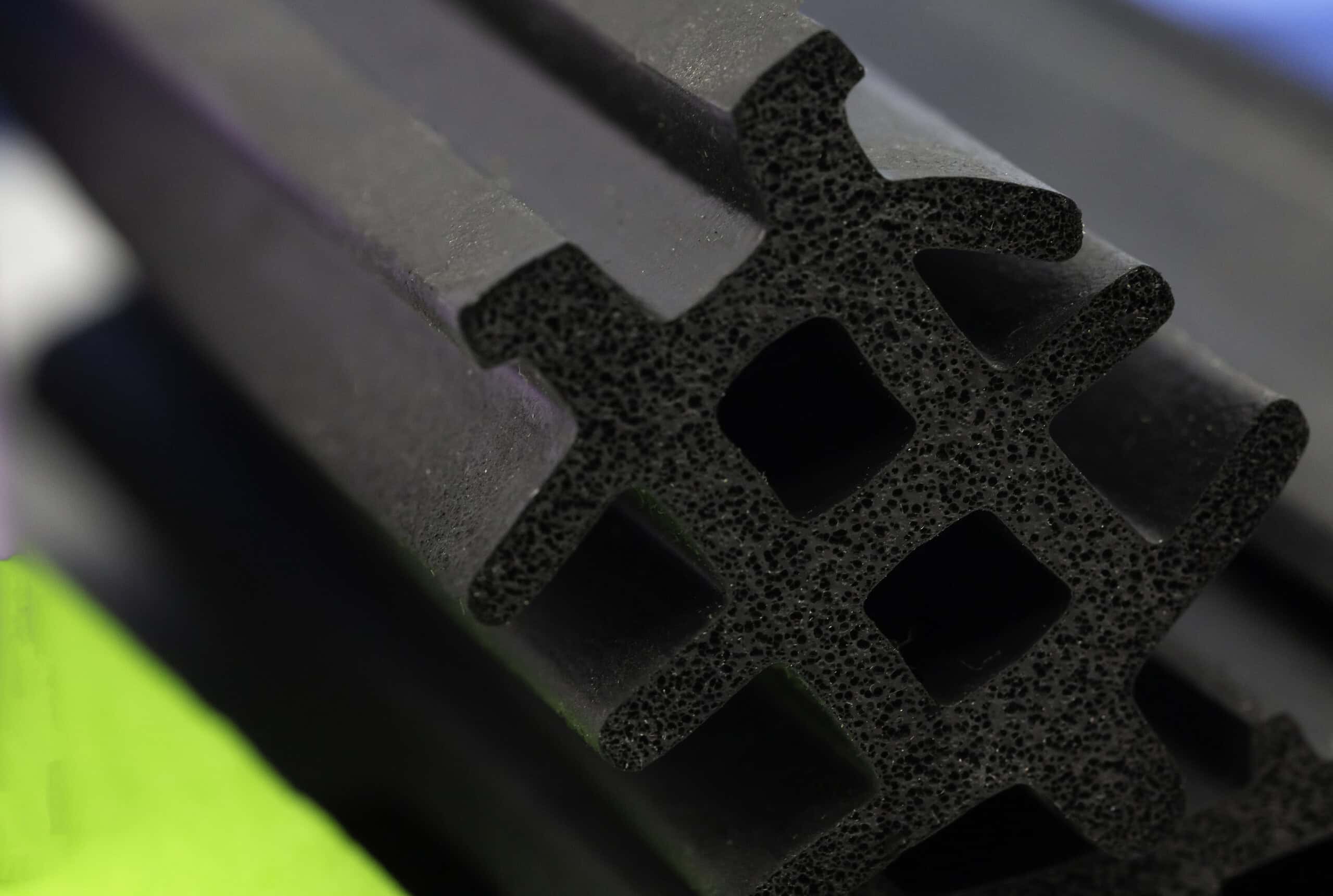
Depending on the requirement, a bespoke profile can incorporate features such as:
- Retaining sections that locate the extrusion within a channel
- Flexible sealing lips
- Hollow sections that provide controlled compression
- Solid areas for support or spacing
- Complex cross-sections designed around surrounding components
The purpose is not necessarily to make the profile more complicated. In many cases, a carefully considered extrusion can simplify the finished assembly by combining functions that might otherwise require several separate parts.
How can bespoke profiles improve assembly efficiency?
For an OEM, component design has to work not only in the finished product but also on the production line.
A seal that performs well once installed may still create problems if operators struggle to fit it consistently.
This is where custom extrusion design can support manufacturing efficiency.
If the profile is shaped to locate positively into a particular channel or housing, it can make installation more predictable. A retaining feature can help the component remain correctly positioned, while an appropriately designed sealing section can provide the required compression after assembly.
This can reduce the need for improvised fitting techniques or repeated adjustment.
Repeatable fit matters in volume production
Small inconsistencies can become much more significant when a product is manufactured repeatedly.
If an extrusion is difficult to seat correctly, an additional few seconds of assembly time may not seem important for one unit. Across hundreds or thousands of units, however, that delay can become a measurable production issue.
The same applies to components that need frequent trimming, stretching or manual modification before installation.
A custom profile developed specifically for the assembly can help minimise those unnecessary steps.
For OEM manufacturers, the aim is usually to create a component that can be installed in a consistent way by different operators without relying heavily on individual judgement.
How do custom extrusions support product consistency?
OEM products need repeatability.
Customers expect one finished unit to perform in the same way as another, and manufacturers need components to fit reliably throughout a production batch.
Custom silicone extrusions can support this by giving the rubber component a defined geometry and specification rather than relying on ad hoc modification of standard material.
Dimensions, hardness and profile design can be established during development and then carried through into production.
This does not mean elastomeric products should be expected to behave like machined metal components. Rubber extrusion has its own realistic manufacturing tolerances, and the component should be designed accordingly.
However, agreeing the relevant dimensions and tolerances before manufacture gives both the OEM and supplier a clearer definition of the required component.
Critical features can then receive appropriate dimensional control while less important areas follow suitable general extrusion tolerances.
This is particularly useful where the profile needs to interact directly with manufactured metal, plastic or composite parts.
Why is silicone useful for OEM components?
Silicone rubber offers a combination of properties that can make it suitable for a wide variety of industrial and specialist OEM applications.
Its flexibility allows components to deform for sealing, cushioning or fitting while retaining useful elasticity.
Silicone is also valued for its resistance to elevated temperatures and environmental influences such as ozone and UV exposure.
These characteristics can be useful where an OEM component has to remain stable across changing operating or environmental conditions.
The precise suitability still depends on the application.
Temperature, chemicals, mechanical wear, pressure, compression and regulatory requirements should all be evaluated when selecting a silicone compound.
There is no single silicone grade that is automatically appropriate for every OEM product.
What design factors matter for OEM silicone components?
The most effective custom extrusion projects usually begin with the function of the component rather than simply its dimensions.
An engineer should consider what the extrusion must actually do once fitted.
For a seal, this may mean identifying the surfaces that need to be sealed, the gap between them and the expected amount of movement.
For a retaining profile, the important issue may be how securely the extrusion needs to fit into a channel.
For a cushioning component, compression and recovery could be more important than achieving a highly precise free-state dimension.
Compression
Silicone seals often rely on compression to function.
Too little compression can lead to poor contact between surfaces, while excessive compression can create unnecessary stress or deformation.
The profile therefore needs to be designed around the available gap and expected movement.
Hollow or bulb sections may be used where greater compressibility is required, while solid sections may be more appropriate where the component needs greater support.
Hardness
Silicone can be manufactured in different hardnesses.
A softer compound may compress more readily, while a firmer material may provide greater resistance to deformation.
The right choice depends on how the profile is intended to behave within the assembly.
Hardness also influences how the extrusion feels during installation, so assembly requirements should be considered alongside final product performance.
Profile geometry
Complexity should serve a purpose.
Adding unnecessary lips, channels or hollow features can make the extrusion more difficult to manufacture without improving function.
A good OEM profile therefore balances application requirements with manufacturability.
Early discussion with a silicone manufacturer can be useful because features that appear straightforward on a drawing may behave differently once produced in a flexible elastomer.
How can custom silicone extrusions reduce the number of components?
One potential advantage of a bespoke profile is the ability to combine several functions into one continuous component.
For example, a profile could potentially include a locating section and a flexible sealing feature within the same cross-section.
Without a custom extrusion, the assembly might require separate components to perform those roles.
Reducing component count can simplify purchasing, stock management and assembly.
It can also reduce the number of interfaces between individual parts, which may be useful where reliable positioning is important.
However, combining functions is only beneficial when the resulting profile remains practical to manufacture and install.
A more complicated extrusion is not automatically a better one.
OEM designers should therefore evaluate whether an integrated profile genuinely improves the product or simply transfers complexity into the rubber component.
What role does prototyping play in OEM extrusion development?
A drawing is an essential starting point, but physical testing can provide information that is difficult to predict from dimensions alone.
Silicone is flexible, so the way a profile behaves when compressed, bent or installed may differ from what its free-state geometry suggests.
Prototype or sample evaluation allows the OEM to assess how the extrusion fits with the actual mating components.
It can reveal issues such as excessive insertion force, inadequate compression, difficult alignment or unwanted deformation.
These findings can then inform design changes before larger production quantities are required.
This can be especially valuable for profiles containing thin sealing lips or hollow sections, where relatively small changes in geometry can significantly affect behaviour.
How do custom extrusions support different OEM applications?
The same extrusion process can be used to create components for a wide range of industrial products.
The important point is that the profile is designed around the application rather than forcing the application to accommodate the profile.
Custom silicone extrusions may be useful where equipment requires a continuous seal around a panel, housing, door or cover.
They may also support products needing flexible spacing, protection or cushioning.
Where a simple rectangular section is sufficient, silicone rubber strips may provide an appropriate solution.
For applications requiring circular or tubular sections, silicone rubber tubing may be suitable.
More complex assemblies may require a completely bespoke extruded shape.
This flexibility allows OEM designers to select the component format that matches the actual engineering requirement rather than defaulting to unnecessary complexity.
What should OEMs discuss with a silicone manufacturer?
The more information available at the start of a project, the easier it is to assess whether a proposed extrusion is realistic.
Providing only a cross-sectional drawing may not explain how the component will be used.
Useful information can include the expected operating temperature, whether the product will be used indoors or outdoors, and whether the silicone will contact oils, chemicals or cleaning agents.
The manufacturer should also understand whether the profile is static or subject to repeated movement.
For sealing applications, expected compression and the dimensions of the surrounding assembly are particularly useful.
OEMs should also identify any dimensions that are genuinely critical to fit or performance.
This makes it easier to distinguish essential tolerances from measurements that can follow normal rubber extrusion practice.
Expected order quantities and required cut lengths may also affect how the product is supplied.
Why should manufacturability be considered early?
One of the main benefits of discussing a profile before a design is completely fixed is the opportunity to identify potential manufacturing difficulties.
Some geometries may be achievable but unnecessarily complicated.
For example, extremely thin features next to heavy solid sections can behave differently during extrusion and curing. Very intricate shapes may also require greater consideration of dimensional stability.
Small modifications to a profile can sometimes make production more consistent without altering its function.
This is why designing an extrusion should ideally be a collaborative process between the OEM and the manufacturer rather than simply handing over a finished drawing after every other component has been finalised.
Considering the rubber component earlier can make it easier to balance performance, tolerances and manufacturability.
How do custom silicone extrusions fit into long-term OEM supply?
Once a custom component has been developed and approved, the OEM needs confidence that future production requirements can be supported consistently.
This makes clear specifications and agreed manufacturing requirements important.
Drawings, dimensions, material details and other relevant requirements provide a reference for future orders.
For procurement teams, having a defined component can also simplify purchasing because the requirement does not need to be reinterpreted every time material is ordered.
Long-term supply planning should take account of forecast quantities, batch requirements and whether components need to be supplied in continuous lengths or cut pieces.
The objective is to make the custom extrusion a predictable part of the OEM’s wider supply chain.
Frequently Asked Questions
Are custom silicone extrusions only suitable for high-volume OEM manufacturing?
No. The suitability of a custom extrusion depends on the application, tooling requirements and expected quantity rather than volume alone. Bespoke profiles can be considered whenever a standard product does not provide the required geometry or function.
Can an OEM provide its own drawing for a silicone extrusion?
Yes. A dimensional drawing is a useful starting point for discussing a bespoke extrusion. It is also helpful to provide information about the application, operating environment, critical dimensions and expected compression so manufacturability can be assessed properly.
Can custom silicone extrusions be supplied in cut lengths?
Extruded rubber products can be supplied in continuous lengths or cut to specified lengths depending on the manufacturing and application requirements. Length tolerances and supply format should be agreed as part of the component specification.
Supporting efficient OEM manufacturing with custom silicone extrusions
Custom silicone extrusions support OEM manufacturing by creating components that are designed specifically for the finished product and its production process.
A bespoke profile can provide controlled sealing, retention, cushioning or protection while fitting directly into the geometry of the assembly.
The benefits extend beyond the performance of the individual rubber component. A well-designed extrusion can improve installation consistency, potentially reduce component count and provide a repeatable specification for ongoing production.
Achieving those benefits depends on considering manufacturability from the beginning.
Profile geometry, silicone hardness, operating conditions, compression, dimensions and tolerances should all be discussed before production is finalised.
Silco Products manufactures silicone rubber products for industrial and OEM requirements, including bespoke components. To discuss a drawing, profile or custom manufacturing requirement, contact Silco Products.
Phone: 01903 732088
Email: sales@silcoproducts.co.uk
Find out more: https://siliconerubberproducts.co.uk/
FURTHER READING