How Do Silicone Seals Maintain Flexibility Over Time?
Silicone seals maintain flexibility over time because silicone rubber is inherently resistant to many of the ageing effects that cause other elastomers to harden, crack or lose elasticity.
For industrial applications, this matters because a seal depends on controlled deformation. It needs to compress, accommodate movement and continue making contact with the surfaces around it. If the material becomes rigid or permanently flattened, sealing performance can gradually decline.
Silicone is often chosen where long-term flexibility needs to be combined with resistance to elevated temperatures, UV exposure, ozone and changing environmental conditions.
However, no seal lasts indefinitely. Material formulation, operating temperature, compression, chemicals, movement and installation all influence how well a silicone component retains its properties over its service life.
Why does silicone rubber stay flexible?
The molecular structure of silicone gives it a useful combination of elasticity and environmental stability.
In practical terms, this means the material can remain flexible across a broad range of temperatures and resist some of the environmental influences that accelerate ageing in other rubber materials.
That flexibility is particularly useful in sealing applications.
A silicone seal may need to compress repeatedly, follow minor surface irregularities or accommodate dimensional movement in the surrounding assembly.
If it can continue doing this without becoming excessively hard or brittle, it is more likely to maintain a reliable sealing interface.
This is why silicone is frequently considered for industrial gaskets, profile seals and other components where long-term resilience is important.
Businesses requiring purpose-made sealing components can explore silicone rubber gaskets for industrial and specialist applications.
How do heat and temperature cycling affect silicone seals?
Heat is one of the biggest long-term challenges for many elastomers.
Prolonged exposure can cause some rubber materials to harden, soften, crack or lose their ability to recover after compression.
Silicone is valued because it generally retains useful elastomeric properties at elevated temperatures better than many conventional rubber materials.
This can help a seal continue performing in equipment that operates hot for long periods.
Repeated temperature changes also matter
Many industrial systems do not remain at a constant temperature.
Machinery may heat up during operation and cool down after shutdown. Outdoor equipment can also experience both internally generated heat and seasonal temperature changes.
These cycles can cause surrounding metal, plastic or composite components to expand and contract.
The seal needs to respond to that movement.
Silicone’s flexibility can help it accommodate repeated dimensional changes while continuing to maintain contact between sealing surfaces.
However, engineers should still consider the complete assembly.
Different materials expand at different rates, so a seal that fits correctly when cold may experience different levels of compression when the equipment reaches operating temperature.
What is compression set and why does it matter?
Compression set is an important consideration for any elastomeric seal.
It describes the extent to which a rubber component fails to return towards its original shape after being compressed for a period of time.
A seal works by maintaining contact pressure.
If it remains permanently flattened, that pressure can reduce and the risk of leakage can increase.
Silicone can provide useful compression recovery, particularly when the compound and design are appropriate for the application.
But material choice alone does not eliminate compression set.
The amount of compression applied to the seal, the temperature, the length of time it remains compressed and the shape of the component all influence long-term behaviour.
Excessive compression can shorten service life
More compression does not necessarily create a better seal.
If a silicone gasket or profile is compressed more than necessary, it may experience avoidable stress.
A better approach is to design the joint so the seal receives enough compression to create reliable contact without being unnecessarily crushed.
This is one reason gasket thickness and profile geometry should be considered alongside material hardness.
For custom components, the manufacturer and designer should ideally agree how the seal is intended to behave after installation rather than considering only its free-state dimensions.
How do UV and ozone affect flexibility?
Outdoor rubber components can be exposed to sunlight and ozone for long periods.
These environmental influences can cause some elastomers to harden, crack or deteriorate at the surface.
Silicone rubber is generally valued for its resistance to UV and ozone exposure.
This helps explain why it can be suitable for external sealing applications where the material needs to remain flexible despite long-term weather exposure.
Examples might include seals around industrial enclosures, external panels, covers and equipment housings.
In these situations, the seal may also experience rainfall, temperature variation and mechanical movement.
Silicone’s environmental resistance can therefore contribute to maintaining useful flexibility across a range of conditions rather than protecting only against one specific influence.
Does silicone remain flexible at low temperatures?
Low-temperature flexibility is another important property of silicone rubber.
Some elastomers become increasingly stiff as the temperature falls.
This can be a problem for seals because reduced flexibility limits their ability to accommodate movement and surface variation.
Silicone generally retains elasticity across a broader temperature range than many conventional rubbers.
That can make it useful for equipment that experiences both cold and hot conditions.
This is particularly relevant to outdoor machinery and systems that may remain inactive in cold conditions before warming significantly during operation.
A seal needs to perform throughout that entire cycle rather than only at room temperature.
How does material hardness affect long-term flexibility?
Silicone can be produced in different hardnesses.
A softer compound will usually deform more easily, while a firmer one provides more resistance to compression.
The correct choice depends on the function of the seal.
A very soft profile may be useful where only light closing force is available or where the seal needs to conform easily to uneven surfaces.
A firmer material may be more suitable where greater support or resistance to deformation is required.
Hardness also affects installation.
A profile that is too stiff may be difficult to insert into a channel, while one that is too soft may distort too readily.
The aim is therefore not simply to choose the most flexible silicone available.
The material needs sufficient flexibility for the sealing function while retaining the mechanical behaviour required by the assembly.
Does profile design influence flexibility?
Yes.
The shape of a seal can influence its behaviour just as much as the rubber hardness.
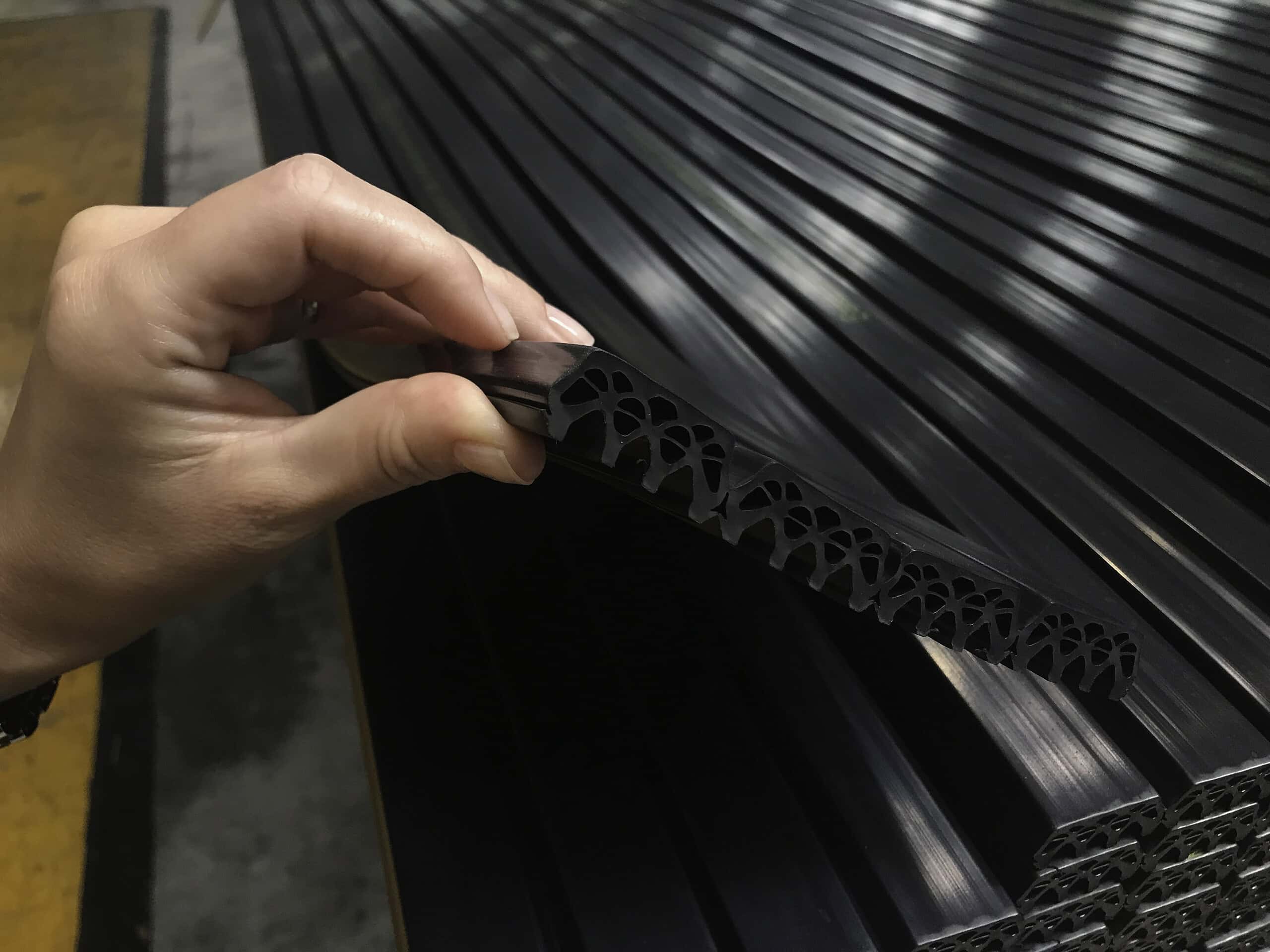
A hollow bulb profile, for example, can compress more easily than a similarly sized solid section.
Thin sealing lips can flex with relatively little force, while thicker sections provide greater support.
This gives engineers several ways to control sealing behaviour without relying solely on the compound.
Custom extrusions can therefore be designed around the required movement, available space and closing pressure.
In some applications, a relatively firm silicone compound combined with a hollow geometry may provide the desired behaviour.
In another, a simple solid silicone rubber strip may be sufficient.
The correct approach depends on the way the component is installed and loaded.
How can chemicals affect silicone seal flexibility?
Environmental resistance does not mean silicone is chemically compatible with every substance.
Contact with unsuitable oils, fuels, solvents or process chemicals can affect rubber properties.
Depending on the substance and compound involved, exposure could cause swelling, softening or other changes that reduce sealing performance.
Cleaning agents also need to be considered.
A seal may be compatible with the normal operating environment but regularly exposed to a stronger cleaning chemical during maintenance.
For this reason, engineers should identify all substances likely to contact the silicone throughout its service life.
Chemical compatibility should then be assessed as part of the material specification.
Choosing silicone because of its temperature or UV performance without checking chemical exposure can result in the wrong material being used for the overall environment.
What effect does mechanical movement have on a silicone seal?
Not all seals are static.
Some may flex repeatedly, move against adjacent surfaces or experience vibration.
Mechanical stresses can gradually damage a component even where the silicone itself remains chemically and thermally stable.
Abrasion is particularly important.
Silicone may not be the preferred elastomer for applications involving substantial continuous sliding or abrasive contact.
A seal designed for movement therefore needs to be assessed differently from one compressed between two fixed flanges.
Surface finish, component alignment and movement frequency all influence durability.
Where possible, the profile should be designed so it can deform elastically without being repeatedly dragged across rough surfaces.
Can poor installation reduce seal life?
Yes.
Even a well-specified silicone component can perform poorly if it is damaged during fitting.
Stretching a seal excessively, twisting it into a groove or forcing it past sharp edges can create areas of stress.
Cuts or small tears may then develop into larger failures during service.
The sealing surfaces should also be prepared appropriately.
Debris, damage or sharp edges can interfere with the fit or gradually abrade the rubber.
For production environments, consistent fitting procedures can help reduce variation between assemblies.
This is especially important for OEM manufacturing, where the same seal may be installed repeatedly across hundreds or thousands of units.
A component that is easy to position correctly can support both reliability and manufacturing efficiency.
How can engineers improve long-term seal performance?
Long-term flexibility begins with understanding the application properly.
Operating temperature, maximum and minimum temperature, chemical exposure, UV exposure and mechanical movement should all be identified.
The seal geometry should then be designed around the available space and required compression.
Critical dimensions need realistic manufacturing tolerances, particularly where the component fits into an existing groove or channel.
Material hardness should reflect both sealing behaviour and assembly requirements.
Engineers should also consider maintenance and accessibility.
If a seal is difficult to replace, long-term material stability may be particularly important.
For critical applications, testing the component under representative conditions can provide useful evidence before full production.
How should maintenance teams inspect silicone seals?
Regular inspection can help identify changes before sealing performance is significantly affected.
Teams should look for obvious physical damage such as cuts, tears or areas where the seal has been displaced.
They should also consider whether the material still feels and behaves as expected.
A seal that has become noticeably harder, remains permanently flattened or no longer makes consistent contact may need replacement.
Visual inspection alone is not always sufficient.
A component can look relatively normal while losing some of its ability to recover after compression.
Where sealing is important to equipment performance, inspection should therefore focus on function as well as appearance.
Frequently Asked Questions
Does silicone rubber become hard with age?
Silicone is generally resistant to many forms of environmental ageing, but its properties can still change over long periods. Temperature, compression, chemicals and mechanical stress all influence how quickly ageing occurs.
Can a compressed silicone seal recover its original shape?
Silicone is elastomeric and can recover after compression, but recovery is not always complete. Compression level, temperature, compound and length of service all affect compression set and long-term shape recovery.
How often should silicone seals be replaced?
There is no universal replacement interval. Service life depends on the application, operating environment, seal design and consequences of failure. Inspection and replacement schedules should therefore be based on actual service conditions.
Maintaining flexibility throughout the service life
Silicone seals maintain flexibility over time because the material offers strong resistance to temperature extremes, UV, ozone and general environmental ageing while retaining useful elastic properties.
These characteristics make silicone suitable for many industrial sealing applications where long-term resilience is important.
The material alone does not determine service life, however.
Compression, profile geometry, hardness, chemical exposure, mechanical movement and installation all influence how a seal performs over time.
A well-designed silicone component should therefore be specified as part of the complete assembly rather than selected purely on one material property.
Silco Products manufactures and supplies silicone rubber products for industrial and specialist applications, including gaskets, strips and bespoke sealing components. To discuss a sealing requirement or custom silicone component, contact Silco Products.
Phone: 01903 732088
Email: sales@silcoproducts.co.uk
Find out more: https://siliconerubberproducts.co.uk/
FURTHER READING