When Should You Choose a Hollow Silicone Profile?
Choose a hollow silicone profile when a door, cover or panel needs a seal that can deflect without using more closing force than the assembly can provide. A hollow section is particularly useful if the gap varies around the opening or if compressing a solid section would make the latch difficult to operate. The profile still needs to make contact at the widest gap and have room to deform at the tightest point.
Picture an illustrative machinery enclosure with a shallow door and a single latch. A solid strip seals well near the latch, but the force needed to close it pulls that edge of the door inwards while the upper corner barely touches the seal. A suitably shaped hollow profile may reduce the load on the door. The way to judge it is to fit a full sample and check contact at that upper corner as well as the effort at the handle.
How does a hollow section reduce closing force?
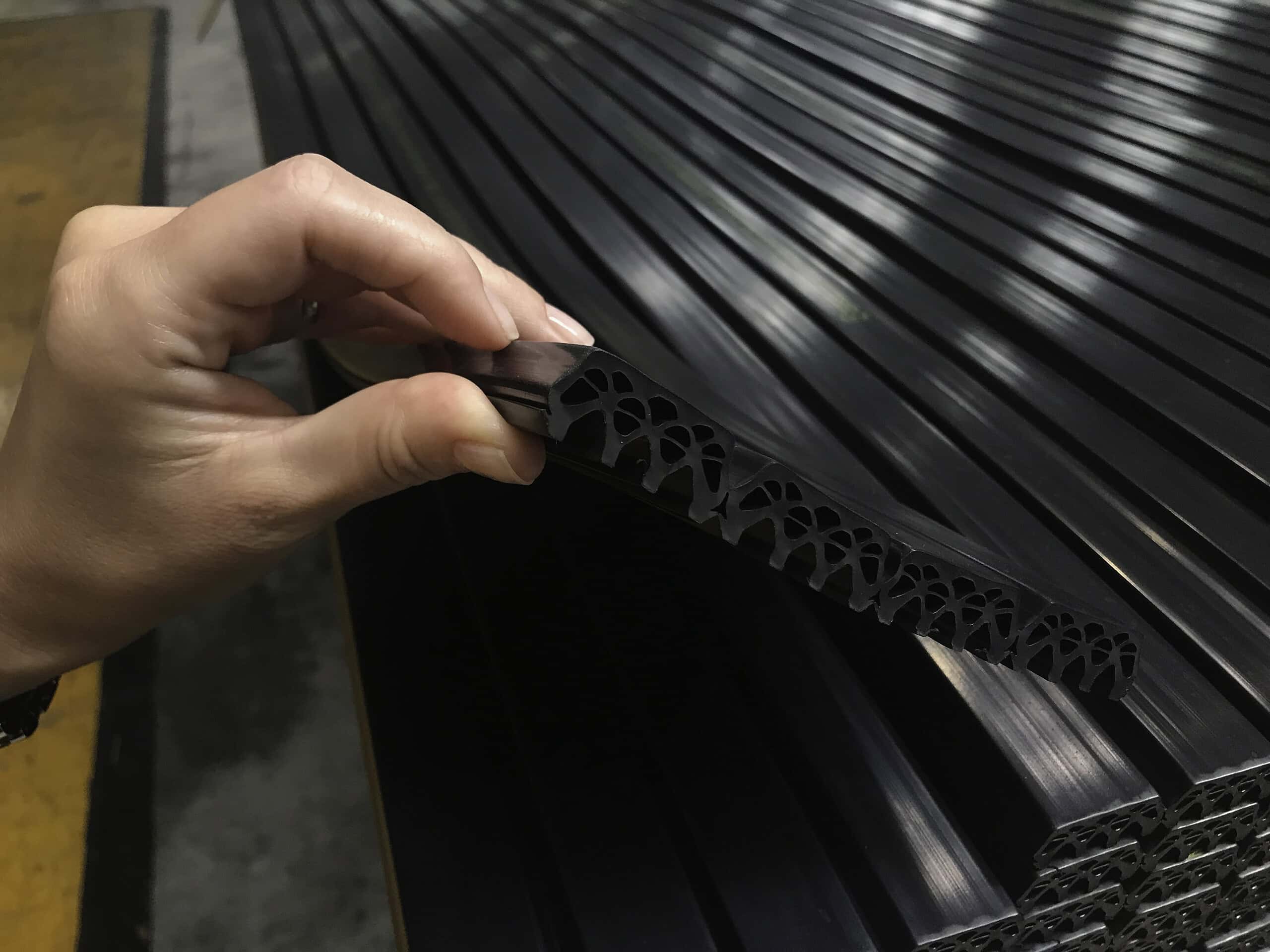
A hollow section has a cavity running along its length. When the cover closes, the walls of the section can flex into that cavity. A solid section also changes shape under load, but the rubber needs room to move sideways as it’s squeezed. Two profiles made from the same silicone grade can therefore require very different forces to compress by the same amount. The cross-section and wall thickness matter alongside the hardness of the compound. TSD 5420
The shape also determines where the rubber moves. A bulb on a flat base may give the seal a stable mounting surface while allowing the top to flex. A round hollow section in a channel needs enough support to stay oriented as the lid closes. If either section folds to one side, it can move the contact line away from the surface it needs to seal against.
Silco Products’ hollow strip catalogue shows several cross-sections with different outer shapes and cavity geometries. When comparing candidates, ask for a section drawing that shows the base, wall thickness and free height. A quote that gives the overall width and height alone leaves out details that affect how the seal will fit and compress. siliconerubberproducts.co.uk
What does the closed gap tell you about the profile you need?
Measure the distance between the seal’s mounting surface and the mating surface with the cover in its intended closed position. For a recessed seal, use the seating face in the channel as your reference. Measure at the hinges, latches, corners and midpoints along unsupported edges. The drawing may show a single nominal gap, while the assembled cover gives you a range.
Suppose a candidate section stands 10 mm high from its seating face when uncompressed. On an illustrative panel, the closed gap varies from 6.5 mm near a hinge to 8.5 mm at the midpoint of the opposite edge. The profile would need to deflect by 3.5 mm at the hinge and 1.5 mm at the midpoint. Those figures describe the travel the seal needs to accommodate. The supplier’s data and the assembly trial determine whether the profile can maintain contact at one end of that range and close acceptably at the other. TSD 5420
Pay attention to where the gap changes. If extra latch force draws in the middle of a flexible panel and leaves the corners farther away, changing the seal alone may be insufficient. The trial can show whether a lower-force section improves contact across the door or whether the panel and latch arrangement need attention too.
When is a solid silicone profile the better choice?
A solid section can be a good choice when the gap is consistent, the joint provides room for the rubber to deform and the fixing arrangement can apply the required load evenly. Consider a rigid cover bolted against a machined face with a controlled gap. If a solid section fits the space and achieves the required seal within the load available from the fixings, the assembly already has the conditions it needs.
A hollow section earns its place when the change in geometry solves a measurable problem. For a hinged panel with a light latch, that could mean reaching the latch position with less handle effort. On a long cover, it could mean accommodating a greater difference between the gaps near supports and those between them. Compare the fitted sections using the same closure settings and acceptance checks so you can see what the change achieves.
| Feature of the assembly | Profile worth evaluating first |
|---|---|
| A light latch or flexible cover limits the force available | A hollow section with a suitable force and deflection range |
| A rigid cover closes to a consistent gap with even loading | A solid section that fits the joint and meets the required load |
| A narrow channel restricts sideways movement | A section whose compressed shape can be checked against the available clearance |
How do corners, joints and retention affect the fit?
Check how the cover approaches the seal. Near a hinge, the cover can sweep across the top of the profile before it reaches its closed position. A seal that performs well when compressed straight down on a bench can roll or drag in that part of the assembly. Retention depends on how the base fits, how far the section projects and how the cover moves across it.
Check corners with the proposed section fitted. A tight bend can distort a hollow profile and reduce contact exactly where the seal changes direction. Where the design calls for a joined frame, inspect the joint for changes in height or stiffness. Silco can join suitable extrusions into rings and frame gaskets, so it’s worth discussing the corner geometry and proposed joint position when you send the drawing. siliconerubberproducts.co.uk
If the ends of the hollow cavity are joined, tell the manufacturer how often the cover opens and how long it typically stays compressed. The way air moves in and out of an enclosed cavity can affect how some hollow seals recover when the cover opens. Agree any vent arrangement with the manufacturer in relation to the sealing surface and the intended use. TSD 5420
What should you check in an assembly trial?
- Map the closed gap. Record the tightest and widest points, where they occur and how the profile will sit in the channel or on the mounting face.
- Fit a full-length or full-perimeter sample. Include the intended corners, joints and retention method. A short sample can show how the cross-section deflects, while the full fit reveals how the latch, hinges and panel interact with it.
- Check force and contact together. Compare closing effort at the same handle position and latch setting. Check that the profile makes contact at the widest gap and has clearance to deform at the tightest point.
- Repeat the checks after representative use. Open and close the assembly as it would be used in service, then check whether the section stays seated and recovers. Where the enclosure has a defined sealing requirement, validate the assembled enclosure against that requirement.
Frequently asked questions
Can two hollow profiles of the same height feel different when the cover closes?
Yes. Wall thickness, cavity shape and compound stiffness can change the force needed to compress the profile. If closing effort is critical, ask for force versus deflection data for the specific section or compare physical samples under the same conditions. TSD 5420
Can I specify a replacement using the old seal as a sample?
An old seal can help identify the cross-section and retention method. Include the channel dimensions and closed-gap measurements as well. A used profile may have taken a permanent set, so its current height alone can give a misleading starting point for the replacement.
Can an existing die produce the section I need?
Silco can check your drawing or sample against its existing dies. Include the acceptable range for the base dimensions and free height, along with the gap and closure requirements. That gives the manufacturer more scope to identify a section worth trialling. Silco Products Ltd
If you’re comparing sections for a new cover or replacing a seal that’s hard to close, send Silco Products the section drawing, your minimum and maximum closed gaps, and details of the hinges and latches. Call 01903 732088 or email sales@silcoproducts.co.uk to discuss a profile for trial.
FURTHER READING